
BIOGRAPHY
“The forms she has pulled from black Belgian marble and Italian marble, from pink alabaster and from coca bole wood, are so sensuous and fluid, they cry out to be touched.”
—Cassai, Mary, “Association Exhibits Powerful Sculptures of Ente,” Daily Freeman, November 23, 2001
Lily Ente (1905-1984) was a mid-century sculptor. She was known for her works in white Italian and black Belgian marble, mastering these merciless stones. Sculpture was the voice Ente used to explore space, balance and form. She later articulated her sculptural ideas through printmaking.
Her works are found in American museums, galleries and private collections and her stone sculptures and unusual monoprints were on display at the Lily Ente Studio, the artist’s refurbished studio in a garden setting in Woodstock, New York. During her lifetime she exhibited in more than 50 group shows and at least five individual shows. After her death there was a major retrospective show at the Woodstock Artists Association & Museum (WAAM) and individual shows at her studio in Woodstock.
Ente became a sculptor in the middle of her life through happenstance. Her cousin arrived for a visit bearing a lump of clay that would change Lily Ente’s life forever.
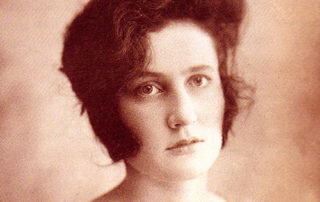
EARLY YEARS
Born Lena Deitchman on or about May 5, 1905 (the exact date is unknown), Lily, as she came to be known, was the third child, first daughter, of Sholom and Anna Deitchman of Dunaevtsy, a small town in the Ukraine, a part of the Russian Empire. Just prior to the start of the First World War, Sholom Deitchman left for the United States to build a better future for his family. Ill-fated events prevented Sholom from carrying out his plan to bring his entire family to the United States. Soon after his departure, the First World War commenced with Russia and Germany as enemies. The Russian Revolution in 1917, causing Russia to cease hostilities with Germany, resulted in civil unrest.
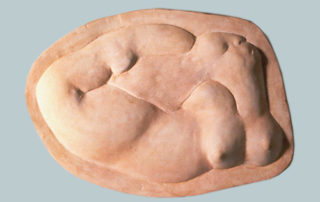
CAREER
Working with clay, Ente soon developed an intense and everlasting interest that would ignite the most important phase of her life. Studying on her own, Ente viewed and studied works in museums and art books. The piece of clay provided by Xenia soon engaged her completely. At first, Ente used her family as models, particularly her daughter Paulette. She found someone to make the molds to cast her pieces into plaster, eventually learning to complete the process on her own. Her bathroom was her casting studio. Ente’s work quickly took on a sophistication and refinement.
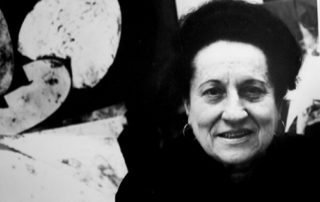
WOODSTOCK
Having exhibited her work at the Mari Gallery on Tinker Street in Woodstock, New York, Ente and her husband began to make regular day trips to this small town, an artist colony, just two hours north of Manhattan. Unsurprisingly, these trips, along with encouragement from Ente’s close friend Mari Huebsch, resulted in Ente and her husband buying a second home in Woodstock in 1962. They converted the barn into their private residence and Ente eventually erected a studio, reusing weather-beaten timbers probably from the old opera house. This uninsulated shack, heated only by an aged rusted stove, would serve as her studio in Woodstock for the remainder of her career.
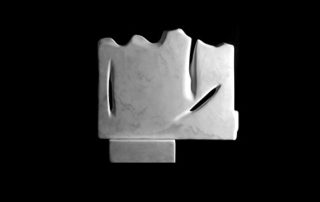
CHRONOLOGY
1905 Born in Russia as Lena Deitchman 1918 Fled Russia with Family following the First World War 1919 Traveled with family to Romania